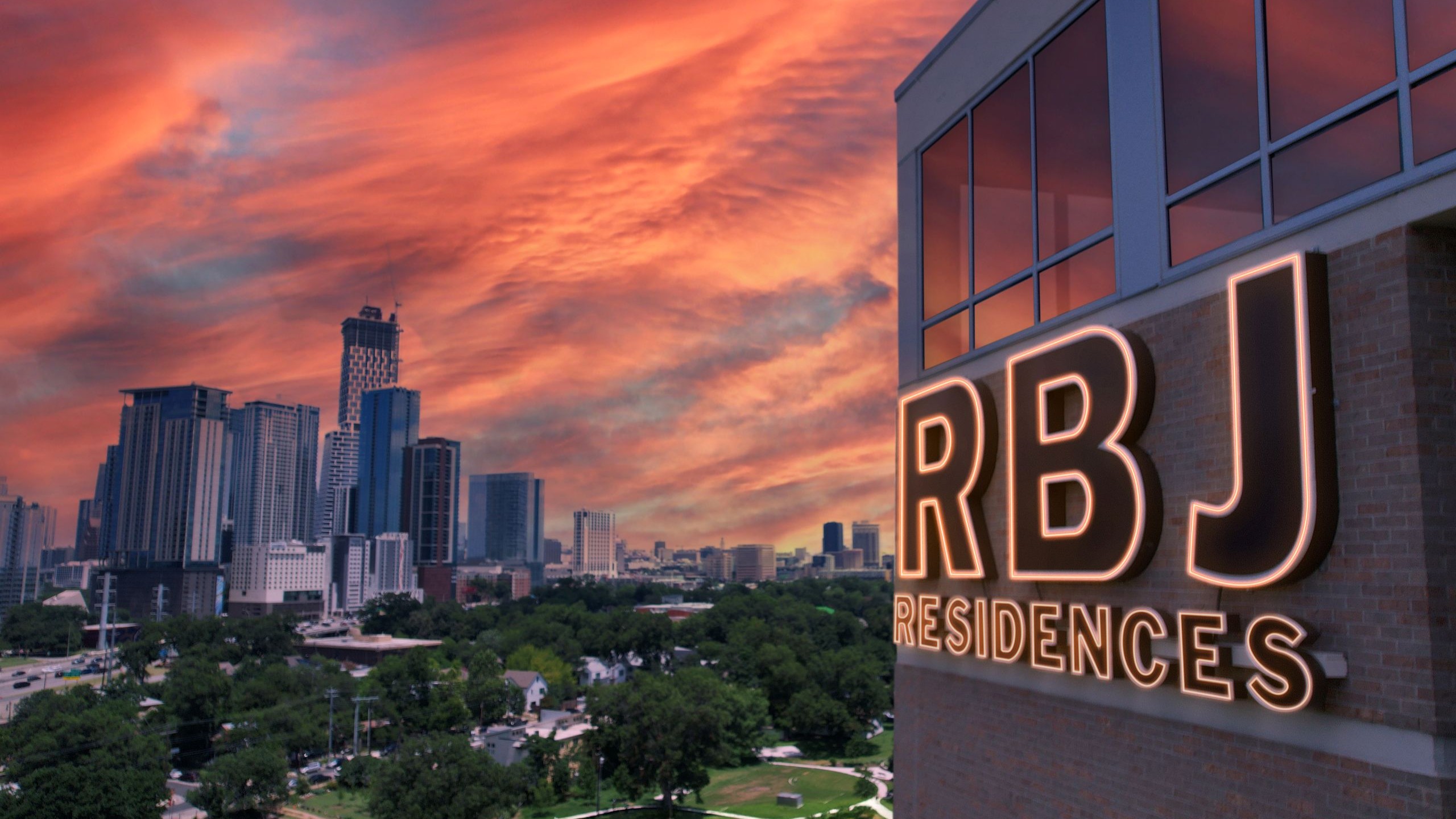
Some milestones take years to reach and this one is worth celebrating. Our East Austin RBJ Residences campus, home to The Rebekah and The Ladybird, has been named a finalist for two significant honors in the affordable housing industry this year:
- 2026 ULI Austin Finalist for Best Project Innovation and Nominee for Most Influential Project
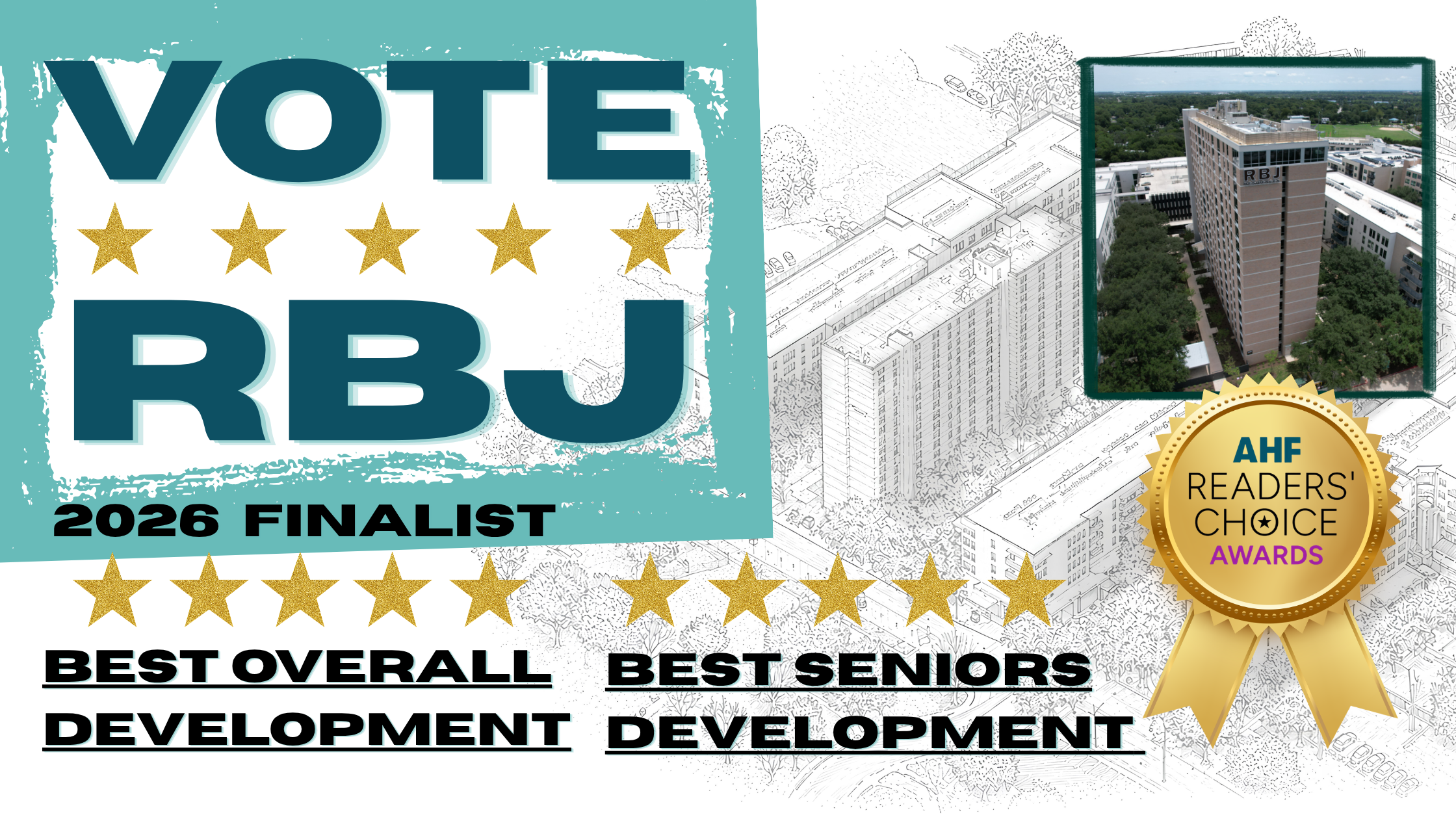
- Affordable Housing Finance Readers’ Choice Awards Finalist for Best Seniors Development and Best Overall Development
This recognition is a celebration of the hard work that lasted more than a decade and involved a host of planners, architects, development professionals, local and state government, and RBJ residents. In this post, we’ll walk through what the redevelopment actually involved, why it’s earning attention from two major industry programs, and what it means for the residents and community we serve.
About the Awards
If you’re not familiar with either awards program, here’s a quick overview of who’s behind them and why they carry weight in the affordable housing industry:
- ULI Austin Impact Awards. Presented by the Austin district council of the Urban Land Institute, a global nonprofit research and education organization focused on responsible land use and community development. The Impact Awards recognize local projects that demonstrate excellence in design, sustainability, and community impact across categories including Best Project Innovation and Most Influential Project.
- Affordable Housing Finance Readers’ Choice Awards. Presented by Affordable Housing Finance, a national publication covering the affordable housing industry. Each year, the program recognizes a small group of standout housing developments from across the country, evaluating projects on their design, affordability model, and approach to services for residents.
AHF Readers’ Choice Awards [Cast Your Vote for RBJ Residences]
Step 1: Subscribe
If you haven’t already subscribed to Affordable Housing Finance, follow this link to subscribe (it’s free and only takes a minute).
Step 2: Vote for RBJ
Once subscribed, follow this link to cast your vote for RBJ in both categories: Best Seniors Development and Best Overall Development.
A Legacy Nearly 60 Years in the Making
Before diving into why this project matters, here’s a quick snapshot of what changed on our 18-acre East Austin campus:
- 279 new affordable apartments were added through the construction of The Lady Bird
- The Rebekah, our iconic 16-story building, was preserved and fully modernized rather than demolished and replaced
- On-site relocation was made possible for existing residents during construction, meaning long-time residents didn’t have to leave the community they called home
- 503 total apartments are now available across the campus, more than double the original capacity
- The campus is now recognized as Central Texas’ largest senior housing community
To understand why this redevelopment matters, it helps to know where the campus came from.
The story starts in January 1969, when President Lyndon B. Johnson, in one of his final acts before leaving office, brokered the sale of a decommissioned federal fish hatchery site on the shores of Town Lake to the newly formed Austin Geriatric Center (AGC), led by Frank Erwin Jr. President Johnson’s vision, shared with AGC, was to build a true continuum of care for the elderly: independent apartments, nursing beds, and a gerontology program developed with the University of Texas. In 1969, that campus-based model of senior care was years ahead of its time.
Construction on the 250-unit, 16-story residential tower and an adjoining 168-bed nursing facility took place between 1968 and 1972. The residential tower was named for President Johnson’s mother, Rebekah Baines Johnson giving The Rebekah its name. While the apartment tower thrived for decades under an FHA-insured mortgage, the nursing home ultimately closed after certification regulations changed mid-construction; the City of Austin later acquired that building and its site, which today houses city and county health service offices and dedicated parkland.
For nearly 40 years, The Rebekah continued to serve Austin’s low-income senior population largely unchanged. But by 2011, two realities were converging: AGC’s original FHA mortgage was set to be paid off in 2013, and the aging tower itself needed significant capital investment. That milestone prompted AGC’s Board to commission a Strategic Master Plan, completed in October 2011 by a team led by HS&A Project Management. The plan evaluated five redevelopment scenarios ranging from modest on-site renovation to a full mixed-use “urban village” incorporating adjacent City of Austin land. A 30-member Strategic Planning Committee, including AGC Board members, neighborhood representatives, and city officials, helped shape the guiding principles behind every option: preserve affordable housing on-site, expand capacity for seniors, and remain good stewards of the land and the neighborhood.
Following that planning process, AGC issued a formal Request for Qualifications in January 2013, seeking a Master Developer to carry the recommended concepts forward. That process ultimately led to the redevelopment that exists today: The Lady Bird’s 279 new apartments and the modernization of The Rebekah Tower.
You can view the original planning documents that shaped this redevelopment: the 2011 RBJ Center Strategic Master Plan Report and the 2013 Request for Qualifications for Master Developer.
Why This Recognition Matters
It’s easy to read “finalist for an industry award” and move on. But for anyone working in, or relying on, affordable senior housing, this kind of recognition matters for a few concrete reasons.
It Signals a Shift in the Industry
AHF’s own summary says the six finalists nationwide “showcase the growing emphasis on pairing affordable housing with services that help older adults age in place and maintain stability.” This reflects a broader shift across the affordable housing industry, away from viewing senior housing as simply a place to live, and toward viewing it as a platform for health, connection, and long-term stability.
It Reflects a Commitment to Residents, Not Just Developments
One detail from the ULI Austin nomination stands out in particular: the ability for residents to relocate on-site during construction. That single decision — rather than displacing residents to make way for new construction — speaks to a broader value that shaped the entire project. Housing redevelopment doesn’t have to come at the cost of community continuity. People shouldn’t have to choose between a better building and staying near their friends, their routines, and the neighborhood they’ve known for years.
It Highlights a Growing National Need
The demand for affordable senior housing isn’t slowing down. As more Americans reach retirement age, and as the cost of both market-rate housing and in-home care continues to rise, the need for affordable, service-connected housing options for older adults is only growing more urgent. Projects like RBJ Residences are part of the answer. They illustrate just how much planning, funding, and cross-sector collaboration it takes to deliver that answer at scale. Recognition from industry programs like these helps keep that need visible to the people who can help address it: developers, lenders, policymakers, and philanthropic partners.
What Makes RBJ Residences Special
So what actually sets RBJ Residences apart? A few key decisions stand out.
- Preservation over demolition. Rather than tearing down the Rebekah Tower, the project team chose to preserve and modernize the existing structure, and in doing so, retaining its architectural identity while bringing it up to modern standards.
- Phased construction with resident continuity in mind. New apartments were built first, allowing existing residents to move within the same campus rather than being displaced to another part of the city during construction.
- A doubling of capacity without doubling the footprint. By adding density thoughtfully across the same 18-acre campus, the redevelopment nearly doubled the number of available apartments. This expanded access to affordable senior housing without requiring a new site.
- A coalition-driven approach to financing and development. Complex affordable housing redevelopments like this one require far more than construction expertise. They require financing partners, legal counsel, tax credit expertise, community engagement, and coordination across public and private sectors.
- A service-enriched model, not just a residential one. The result of this redevelopment is more apartment and more capacity for the kind of service coordination and community programming that helps residents age in place successfully.
What’s Next
Winners of the ULI Austin Impact Awards will be announced at the 2026 Impact Awards on Aug. 26 at Austin PBS at ACC Highland. Winners of the Affordable Housing Finance Readers’ Choice Awards will be recognized at AHF Live: The Affordable Housing Developers’ Summit, Nov. 16-18 in Chicago. We’ll share updates on both as they come.
Want to learn more about The Rebekah and The Ladybird, or life at RBJ Residences? Visit our leasing website and schedule a tour. We’d love to show you around.